Ragnar Loðbrók Isn’t Real: The Limits of Treating Sagas Like History
Adam Bierstedt
Ragnarr Loðbrók is perhaps the most famous Viking in modern consciousness. Between History Channel’s ›Vikings‹ and ›Assassin’s Creed: Valhalla‹, this 9th century Scandinavian king dominates the image of an egalitarian society, where a farmer can, through his own brilliance, perform famous deeds and becomes a renowned, conquering king, whose death causes his sons and loyal drengir to invade and conquer most of England in the Great Viking Army.
Adam has a BA in Medieval Studies from the University of Chicago and an MA in Viking and Medieval Norse Studies from the University of Iceland. His MA research focused on the politicization of environmental events at the end of the Icelandic Commonwealth in the 13th century, particularly in the years 1257-1262. His current research projects focus on the continued reception of the Norse sagas both in the Middle Ages and in modern media, particularly focusing on spatial and social relationships within these adaptations. He has presented this research at numerous national and international conferences, including the International Medieval Congress at Leeds and, upcoming in 2021, at the 18th International Saga Conference. He also has done public history education on the Vikings as a flaired contributor on r/AskHistorians, in consulting and video work with the Youtube channel Overly Sarcastic Productions, and via livestreams on Twitch under the handle Ludohistory.
There’s just one small problem – This Viking King, as we imagine him, didn’t exist.
In this post, I’ll examine all the evidence for Ragnarr Loðbrók’s existence and legend, beginning with the sagas and then looking at continental evidence. I use it here as a gateway to briefly consider how we can use the Norse sagas as historical sources more broadly, and the centuries-long adaptation of the Vikings into legend.
The Norse sagas about Ragnarr
Any discussion of Ragnarr should begin with the best-known versions of his tale, found in 13th and 14th century Scandinavia. There are two main versions of his life, two found in prose sagas, ›Ragnars saga loðbrókar‹ and ›Þáttr af Ragnarssonum‹. The former is found in the manuscript NKS 1824b-4 to immediately following ›Völsunga saga‹, which has been interpreted as a sort of prequel saga to it – there are many structural parallels in e.g. Ragnarr’s death and that of Gunnar Gjúkason at the hands of king Atli.
Both of these sagas agree in the main details – Ragnarr is the son of the legendary Sigurðr Hring, the king of Denmark. An ambitious young noble eager for renown, his chance comes when the daughter of the king of the Geats, Þora, is trapped by a pet snake that has grown into a dragon. To protect himself, Ragnarr boils a hide shirt and trousers in pitch, making invulnerable armor, and giving him his byname (which literally translated as “Hairy Trousers”, though Fuzzypants is both more fun and still quite accurate!) When it is revealed he did the deed, he is married to Þora, and they have two sons before Þora dies of illness.
Griefstricken, King Ragnarr abandons Denmark to go raiding, and it is on a raid in Norway that he meets a beautiful farm-maiden, who is eventually revealed to be Áslaug, the daughter of Sigurðr of the Völsungs and the Valkyrie Brynhildr. He is enamored of her, and after some trials, rathey are married, having four children: Ívarr beinlausi, Björn járnsíða, Hvítserkr (White-shirt), and Sigurðr Ormr-i-auga. These four avenge the death of Ragnarr’s sons at the hands of the Swedish king Sigtrygg, and Ragnarr incorporates the land into his Scandinavian empire.
Ragnarr’s death occurs some years later, as his sons are raiding in the Holy Roman Empire and Italy. He, growing jealous of them, decides to conquer England using only two ships. Áslaug warns him against this, but weaves a white shirt for him that will protect him from harm. He is captured by the king of Northumbria, Ælla, and because he refuses to tell Ælla who he is, he is thrown into a pit full of snakes – at first the shirt protects him, but then Ælla’s men remove it and he then dies. His sons, on hearing of this, invade England and, thanks to Ívarr’s trickery, capture Ælla, execute him horribly by “marka örn á baki honum sem inniligast, ok þann örn skal rjóða með blóði hans.“ [carving an eagle on his back the most precisely, and then the eagle shall turn red with his blood], and continue to conquer England.
The other main tradition is found in Saxo Grammaticus’ ›Gesta Danorum‹, dating to around 1000. This has a significantly, though not entirely, different narrative arc. Ragnar is still the son of Sigurðr Hring, but his first wife was Lagertha, a female warrior who fought in his army as he avenged his grandfather’s death – she gave birth to two unnamed daughters and a son named Fridlef (Friðleif). Ragnar eventually divorces her after the same dragon-slaying and marries Þóra, with whom he has many children: Rathbarth, Dunvat, Sivard, Bjorn, Agner, and Ivar – he eventually has another son, Ubba, out of wedlock after Þóra dies of illness.
Ragnar ravages across Europe, including conquering England, Scotland, and Ireland, defeating Charlemagne in battle in Saxony, conquering the Hellespont, and subduing the Saami people of Bjarmaland. Ragnar’s reign across Europe is not peaceful, as his sons fall in battle, and one Harald (most likely supposed to be Harald klak, who visited the court of Louis the Pious in 815) continues to raise revolts in Denmark. Eventually, Ella, the son of the king of England before Ragnar conquered the country, captures Ragnar, drops him a pit of snakes, and Ivar and his brothers avenge his death before dividing up his lands.
These two main legendary strands clearly are derived from the same oral traditions – Ragnar’s winning of Þóra is practically identical, as is his death in Northumbria. However, they are just as clearly not identical nor historical – Lagertha, despite her prominence in the television show, is likely an invention by Saxo, and one which fits into a type of saga trope of the meykonungr, or Maiden-king (Su 2019) – a warrior-woman who sets a challenge for the male hero, who overcomes them and marries her, often against her will. She, therefore, likely is an invention from contemporary literature, introduced by Saxo to the narrative. Additionally, the two strands appear to be completely unaware of the historical King Ælla – the so-called ›Anglo-Saxon Chronicle‹states that in 867, “there was much dissension in that nation among themselves; they had deposed their king Osbert, and had admitted Ælla, who had no natural claim.” He is not a king, the son of a king, who ruled for many years over the Northumbrians – he was a pretender to the throne that was embroiled in a civil war. A third example from ›Ragnars saga‹ and ›Þáttr af Ragnarssonum‹comes in the patently absurd claim that Ívarr founded the city of London (in the þáttr) or York (in the saga) – both are founded by the Romans several centuries earlier. As such, it’s clear that the narratives as they are preserved in these late sources are not fully historical.
While these two strands represent the main narratives surrounding Ragnarr, they are not the only ones to mention him. Ragnar Loðbrók is mentioned in the 12th century ›Íslendingabók‹ as the father of Ívarr, who killed St. Edmund, and in ›The Book of Settlements‹ as the ancestor of one particularly prominent family in Breiðafjörður. Additionally, there are two skaldic poems that are related to the Ragnar legend – ›Ragnarsdrápa‹, composed by Bragi Boddason, supposedly in Ragnar’s honor, and ›Krákumál‹, which purports to be Ragnar’s death poem, and references Þóra and Áslaug by name.
The former is one of the oldest known pieces of skaldic poetry, but doesn’t actually mention Ragnar by name, while the latter poem is found in the same manuscript as ›Ragnars saga‹ and ›Völsunga saga‹, but probably predates them, with scholarly consensus generally dating it to the 12th century, and therefore part of the oral tradition that also produced the other versions of the Ragnar legend. As such, neither of them provide any sort of independent corroboration of Ragnar’s existence.All of these sources, save ›Ragnarsdrápa‹, share the same issue – they postdate Ragnar’s death by some four hundred years. While they are all participating in or derived from older oral traditions, both ›Ragnars saga‹ and the ›Gesta Danorum‹ freely fabricate material, and have not been taken as straightforwardly historical for over a century (Ó Corráin 1979, 284). It is therefore worth looking to Non-Norse sources for further evidence of the existence of Ragnar.
Medieval Continental Sources for Ragnarr and his sons
While there is a fairly diverse set of sources that touch upon the Ragnar legend and its historicity, they can be divided into two groups, those that discuss the 845 siege of Paris and those that describe the “Ragnarssons” and the Great Viking Army.
The 845 sack of Paris is recorded in a few Frankish sources. They all describe a certain Reginherus as the leader of the warband, who sacks the city. However, a disease outbreak of some kind killed him later that year. According to the ›Annals of St. Bertin‹, which does not mention Ragnar by name, says:
Nortmanni , alveo Sequanae remenso, maria repetunt, cuncta maris loca finitima diripiunt, vastant atque incendiis concremant. Sed licet peccatis nostris divinae bonitatis aequitas nimium offensa taliter christianorum terras et regna attriverit, ne tamen etiam pagani improvidentiae aut certe impotentiae Dominum omnipotentissimum ac providentissimum inpune diutius insimularent, cum a quodam monasterio [Sithdiu nomine] direpto incensoque oneratis navibus repedarent, ita divino iudicio vel tenebris caecati vel insania sunt perculsi, ut vix perpauci evaderent, qui Dei omnipotentis iram ceteris nunciarent. – Georg Waitz (Hrsg.), Scriptores rerum Germanicarum in usum scholarum separatim editi 5: Annales Bertiniani, Hannover 1883, S. 33.
Nevertheless, so that the pagans should no longer go unpunished in falsely accusing the most all-powerful and most provident Lord of improvidence and even powerlessness, when they were going away in ships loaded with booty from a certain monastery which they had sacked and burned, they were struck down by divine judgement either with blindness or insanity, so severely that only a very few escaped to tell the rest about the might of God. – Annals of St. Bertin, trans. Janet Nelson, Manchester 1991, S. 61.
This Reginherus appears to 1) be related to King Horik of Denmark and 2) a very successful war leader, but apart from this one mention, very little of his life is known – it has been argued that he had a short-lived alliance with Charles the Bald, but this is still uncertain (Lukman 1976). A vast majority of the references to Ragnar or to Loðbrók (the two names never occur together outside of Scandinavia) refer only to their sons, particularly Ívarr the Boneless.
The „Ragnarssons,“ particularly Ivarr beinlausi, Halfdanr (possibly bynamed Hvitserkr), and Bjorn Ironside (but probably less Sigurðr snake-in-the-eye – he’s mentioned exactly once in a non-Norse source) are considered to be historical figures due to their presence in records from outside of Scandinavia. Ivarr is attested in Early English and Irish annals (usually as Yngvar, an older form of the name), Hálfdanr is attested in annals and in charter evidence from Northumbria, Bjorn Ironside is found in Frankish and Galician annals, and the voyage he led into the Mediterranean alongside Hásteinn is attested in Islamic sources. With such a wide-ranging set of sources, it’s hard to deny that these leaders are historical. They seem to have referred to themselves as brothers, and Asser’s ›Life of Alfred‹ refers to them as such.
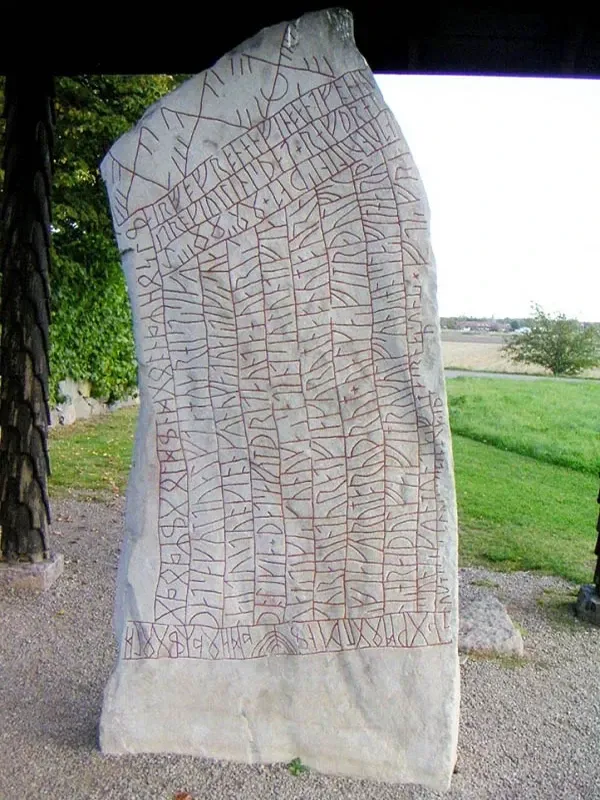
Rök Runestone, Östergöland, Sweden, which records a story potentially related to Ragnar.
In the Irish tradition, there are only two potential mentions of Ragnar: One in the ›Cogad Gáedel re Gallaib‹, where Hálfdanr is recorded as the son of “Ragnaill” and one in the 12th century ›Fragmentary Annals‹, which preserves a tale similar to ›Ragnars saga‹. Meanwhile, Adam of Bremen refers to Ívarr as “the son of Lodparchus” in the 1070s, while the ›Annals of St. Neots‹ lists a “Raven Banner” as being woven by the “daughters of Lodebroche,” who are the sisters of Hingwar and Hubbe (i.e. Ívarr and Ubba).
This Loðbrók, however, may not even be male! While Adam of Bremen’s Lodparchus is clearly a male name, a runestone at Maeshowe in the Orkney Islands reads “This mound was built before Lodbrok’s. Her sons, they were bold. Those were real men, such as they were.” The Old Norse is highly unambiguous about Loðbrók being a female name, and Rory McTurk has proposed, on the basis of this, that a poem in the main redaction of ›Ragnars saga‹ should be reinterpreted to read “Loðbróka’s sons” instead of the usual “Loðbrók’s sons.”If we accept this runestone as reflecting historical reality, then Ragnar Loðbrók’s identity is case further into doubt. Certainly, whoever he may have been most likely did not wear remarkably fuzzy pants, and there is no particular reason beyond the legendary tradition to link him to the kings of the Great Viking Army. Even so, it is tempting to conclude that he is an amalgamation of these two real people – Rory McTurk argues as such in his 1976 and 1991 studies of ›Ragnars saga‹. There was some Ragnar, he just wasn’t as great a king as the sagas claim he was.
Sagas as History
There are many fundamental inconsistencies with the narrative of Ragnar Loðbrók: The two Scandinavian strands have impossible errors in chronology and plot to each other and to Continental sources, including Ælla’s reign and death, and even who all the Ragnarssons were (Hálfdanr is notably absent from the saga tradition). The Continental sources never link Reginherus to their focus on the Ragnarssons. It is entirely possible that the two are related, but it is inherently somewhat speculative. Moreover, Reginherus is never associated the dubiously-sourced Lodparchus of Adam of Bremen, making it untenable to argue for a single Ragnar Loðbrók at any point before the 12th century. Any historical figure there was bears little resemblance to the saga narrative that we know. Even Rory McTurk, in the same breath as he postulates a conflation of the historical figures as described above, he acknowledges that he views Ragnar Loðbrók “as a legendary figure, not a historical one.” (1991, S. 1)
However, that does not mean that ›Ragnars saga‹ is useless as a historical source! Every saga genre has some information about the culture, values, and indeed sometimes events of the 9th century, such as a raid on the Italian town of Lúna, led by Björn járnsíða! However, as Jóhanna Katrín Fríðriksdóttir notes, we have to be careful to sift through the layers of invention in order to get there. The Legendary sagas, the genre to which our prose sagas fit into, are by and large less historical than others. As such, the best way to treat these texts is as a form of early historical fiction. Saxo and the author of ›Ragnars saga‹ freely combine folklore, previous written accounts, and their own inventions for the sake of their story. The stories being told, though, are in some way resonant and are copied numerous times in the following centuries. The sagas, therefore, serve as an inconsistent source for the Viking Age and an excellent source for post-Viking mentalities.
The legendary King Ragnarr was cemented in the Icelandic cultural context by the 12th century, as both ›Íslendingabók‹ and ›Landnámabók‹ trace the ancestry of prominent Icelanders to sons of Ragnar Loðbrók, and the former dates the discovery of Iceland to the martyrdom of St. Edmund at the hands of Ívarr beinlausi. The legend, therefore, explains cultural concerns and the prominence of certain Icelanders through the projection. The narrative of the son of a king who leaves his home and in a different country wins fame and renown, and whose sons repeat that feat on a much larger scale, offers great resonance to the Icelandic founding mythology, as high-ranking Norwegian nobles fled Haraldr harfagri’s court to seek renewed renown in Iceland.
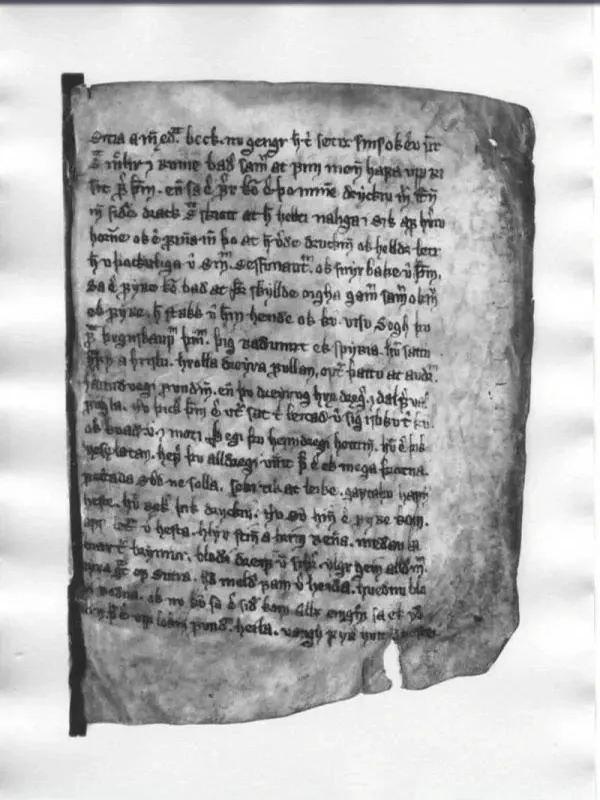
Ragnars saga in NKS 1824 b 4to, c. 1400.
In the 14th century, after Iceland’s annexation by the Norwegian king, it serves a slightly different purpose. The saga points towards a unified, powerful Scandinavia, dominant on the European stage. As Hákon IV and Valdemar I brought in new forms of literature and French courtly culture, it is easy to imagine a sort of soft backlash to that, hearkening back to an imagined golden age of specifically Scandinavian importance.
Finally, the main manuscript of the saga dates to c. 1400. At this point, the political context of Scandinavia looked different yet again, and Ragnar fits a new purpose. In 1397, Denmark and Norway (including Iceland) unified in the Kalmar Union, bringing the two kingdoms together for the first time since the 11th century. ›Ragnars saga‹here can be read as sort of aspirational – it imagines a time when a unified Scandinavia, under the Danish crown, achieved cultural renown for a time. It also could be seen as a warning to the new queen of arrogance and reaching beyond her measure, as Ragnar’s jealousy of his sons leads to his death and his kingdom’s disintegration. The political contexts therefore plausibly influence the composition and copying of Ragnar’s legend, proving that throughout the Middle Ages, this great Viking leader had something people could relate to.
It’s appropriate, therefore, that Ragnar Loðbrók of all the Vikings is the one who has achieved the highest renown in the 21st century. Ragnar, himself an imaginary perfect Viking, has been parsed through American success stories, turning from a nobleman by birth to a farmer, who through his own talents becomes a giver of rings and leader of men. He, to modern capitalist society just as to medieval Icelanders, is the manifestation of our founding mythologies and ideals. Regardless of whether or not he is based on any historical figures, that makes the saga of him and his fuzzy pants worth telling.
Bibliography
Anglo-Saxon Chronicle, trans. James Ingram, London 1823. Part of the Avalon Project, New Haven 2018 (https://avalon.law.yale.edu/subject_menus/angsax.asp).
Annals of St. Bertin, trans. Janet Nelson, Manchester 1991. Part of Anders Winroth, ed, Viking Sources in Translation, Web, New Haven 2006.
The Saga of Ragnar Loðbrók and His Sons, trans. Chris Van Dyke, 2003. Accessed at http://www.germanicmythology.com/FORNALDARSAGAS/RagnarsSagaLodbrokar.html
Saxo Grammaticus, The History of the Danes, Books I-IX: I. English Text; II. Commentary, trans. Hilda Roderick Ellis Davidson, Suffolk 1998.
Þáttr af Ragnars sonum, trans. Peter Tunstall, 2005. Accessed at http://www.germanicmythology.com/FORNALDARSAGAS/ThattrRagnarsSonar.html.
Donnchadh Ó Corráin, “High Kings, Vikings, and Other Kings”, in: Irish Historical Studies 22, no. 83 (1979), p. 283-323.
Jóhanna Katrín Fríðriksdóttir, Valkyrie: The Women of the Viking World, London 2020.
Minjie Su, In Search of Lagertha, the Warrior Queen. Medievalists.net, 2019. accessed at https://www.medievalists.net/2019/06/in-search-of-lagertha-the-warrior-queen/.
Niels Lukman, An Irish Source and some Icelandic fornaldarsögur, in: Medieval Scandinavia 10 (1976), p. 41-57.
Rory McTurk, Ragnarr Loðbrók in the Irish Annals?, in: Bo Almqvist / David Greene, Proceedings of the seventh Viking Congress, Dublin 1976, p. 93-124.
Rory McTurk, Studies in Ragnars saga Loðbrókar and its Major Analogues, Oxford 1991 (= Society for the Study of Medieval Languages and Literature. Medium Aevum Monographs 15).